
Training
Check sheet phases explained: construction, pre-commissioning and commissioning
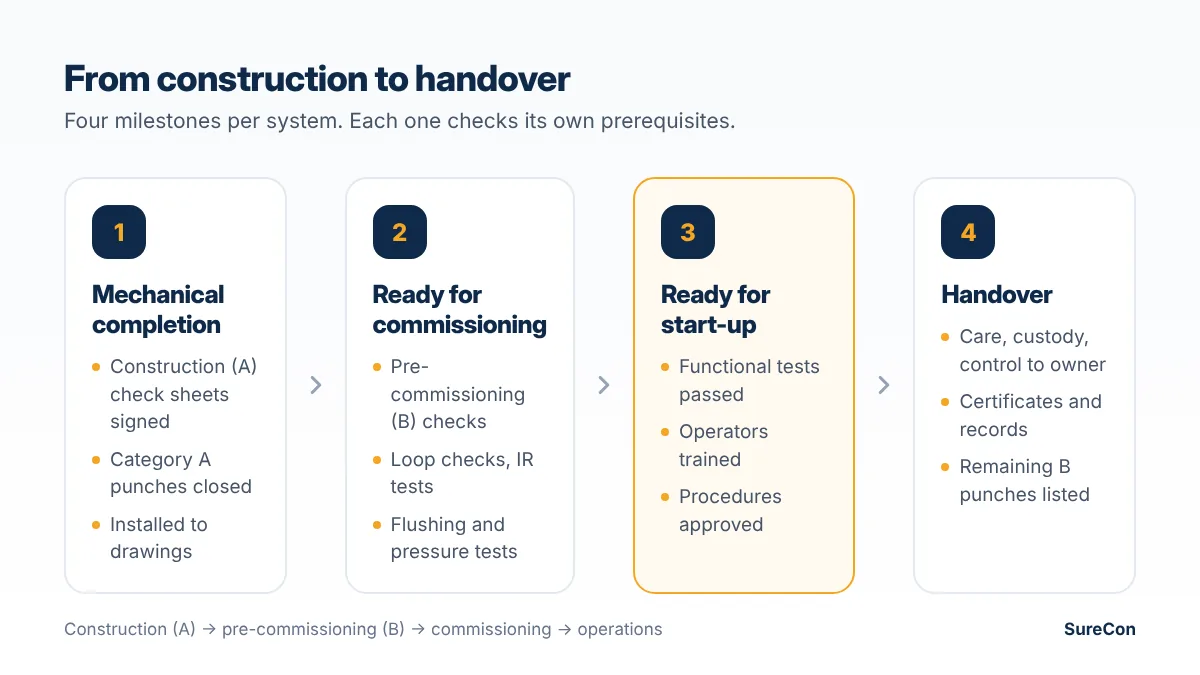
Why check sheets come in A, B and C phases, what each one proves, and how the phases line up with the completion milestones.
· 7 min read

Check sheets, also called inspection and test records (ITRs), are where the real evidence lives. They're split into phases because the same piece of equipment is checked several times: once when it's installed, again before it's energised, and again when it runs.
A sheets: construction
Construction check sheets prove the item was installed correctly: in the right place, to the right drawing, with the right materials, bolted, grouted, aligned, terminated and labelled. They're usually signed by the contractor and verified by QC. All A sheets signed is the heart of mechanical completion.
B sheets: pre-commissioning
Pre-commissioning checks prove the item is ready to be energised or filled, without process fluid or full function. Insulation resistance tests, loop checks, flushing, pressure tests, motor rotation checks. They make up most of the work between mechanical completion and ready for commissioning.
C sheets: commissioning
Commissioning checks prove the item works as designed with the system running: run tests, function tests, performance tests, alarm and trip tests. They lead to ready for start-up and, eventually, handover.
Why the split matters
- Safety: no one energises a motor whose cables haven't been tested.
- Clear ownership: construction owns A, commissioning owns B and C.
- Honest progress: a system isn't 'nearly done' because its A sheets are.
- Faster handover: each phase's evidence is already in the right place.
Good habits
- Fill sheets in at the equipment, on the day, not from memory in the office.
- Record measured values, not just ticks. 'IR 2,000 MΩ at 1,000 V' beats 'OK'.
- Attach a photo where it proves something: an alignment reading, a nameplate, a label.
- Don't let A sheets pile up unsigned. Each one blocks a certificate later.
In SureCon
Check sheets are created per tag from templates for each phase, filled in on a phone (offline too), with readings checked against limits. The ITR matrix shows every tag against every sheet, so you see at a glance which phase each subsystem has reached.