
Training
How to make sure nothing is missed at handover
Missed checks and forgotten punch items are the most expensive mistakes in completions. Ten practical controls that catch them before the client does.
· 8 min read
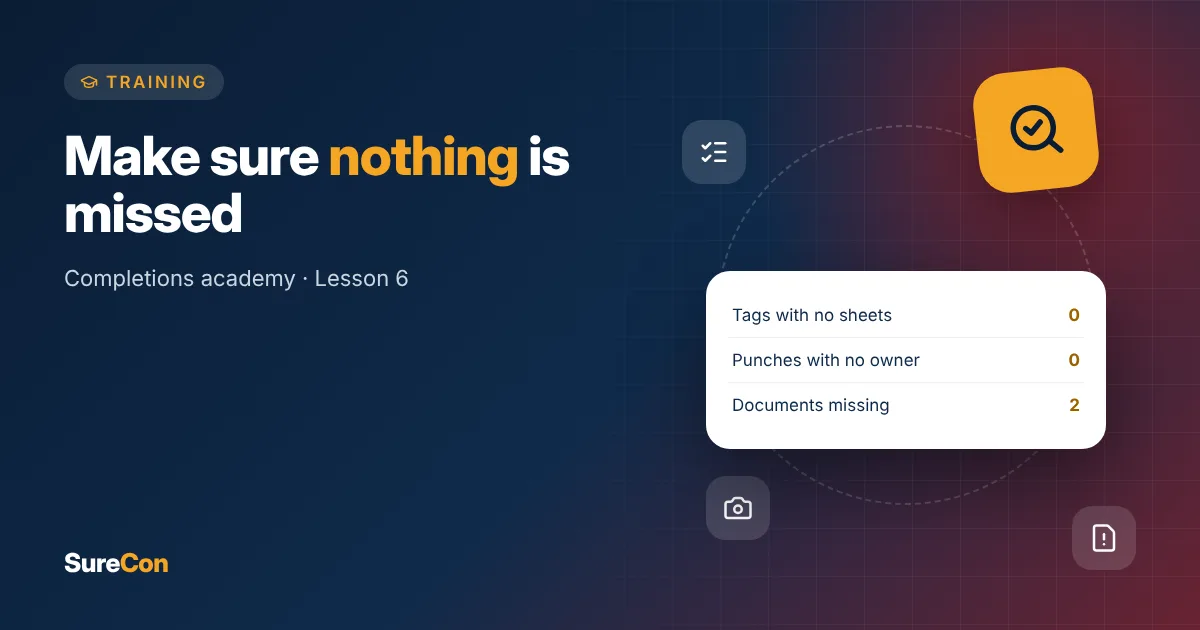
What gets missed is rarely the big stuff. It's the cable that was never IR tested, the valve that was never added to the tag list, the punch item written on a whiteboard and wiped, the vendor manual that was never received. Each one becomes a delay at start-up or a problem in operation. These ten controls catch them.
1. Start from a complete register
You can't miss a check you know about. Reconcile the tag register against every engineering list (equipment, instrument index, cable schedule, line list, valve list) and against the drawings. Tags without a subsystem, and drawings with tags not in the register, are your first gaps.
2. Generate the checks, don't list them by hand
If every tag gets its check sheets from a matrix, the list of checks is complete by definition. Hand-made lists always miss something.
3. Every punch in one place
Punches in notebooks, emails, walkdown spreadsheets and whiteboards get lost. One punch list, raised on a phone at the point of discovery, with a photo, is the only reliable way.
4. Every item has an owner and a date
Unassigned items don't close. Make company and due date required, and review the unassigned list every week until it's empty.
5. Certificates check prerequisites automatically
Let the system refuse a mechanical completion certificate while A sheets are unsigned or A punches open. People forget; rules don't.
6. Walk down every system before each milestone
A formal walkdown with construction, commissioning and the client, against the drawings, catches what paper can't: missing supports, wrong labels, damaged insulation. Record findings straight into the punch list.
7. Track documents like equipment
Vendor manuals, certificates, as-builts and test records should have their own register with due dates, linked to the tags they cover. A missing manual should show up as a gap, not a surprise.
8. Keep preservation going
Equipment that sits for months needs its shaft turned, heaters on and seals checked. Scheduled routines with recorded checks protect the warranty and catch damage early.
9. Control changes
A design change after a sheet is signed can make that sheet wrong. Management of change should list the tags and documents affected, so the right sheets are redone.
10. Review exceptions weekly
- Tags with no check sheets.
- Sheets with no signature older than two weeks.
- Punches with no company or due date.
- Overdue punches by company.
- Subsystems due for a milestone with blockers.
- Expected documents not received.
The goal isn't to find everything at the end. It's to make every gap visible the week it appears.
In SureCon
Sheets are generated per tag, punches are raised on a phone with photos, certificates check their prerequisites, and the turnover tracker and ITR matrix show every gap by subsystem. Scheduled reports send the exception lists to the right people every week.