
Training
What is construction completions? A plain-English introduction
Completions is how a project proves that everything was built, checked and tested before it's handed over. Here's what it means, who does it and why it matters.
· 7 min read
Every project ends the same way: someone has to prove that what was built is complete, safe and ready to use. On a house, that's a final inspection and a walk around with the owner. On a plant, a data centre, a hospital or a mine, it's thousands of pieces of equipment, tens of thousands of checks and a pile of certificates. The work of planning, recording and proving all of that is called completions.
Completions in one sentence
Completions is the process of proving, system by system, that the work is finished, checked, tested and documented, so it can be safely commissioned and handed over.
Why it exists
On a large project nobody can remember what has been checked. Without a system, the last months turn into a scramble: inspectors re-check things that were already checked, punch lists are argued over, and the handover dossier is put together from memory. Things get missed, and the things that get missed are the ones that cause incidents, warranty claims and late start-up.
Completions replaces memory with a register. Every item that needs checking is listed in advance, every check leaves a signed record, and every defect is tracked until it's closed. At any moment you can say exactly what's done and what isn't.
The building blocks
- Systems and subsystems: the project is split into parts that can be finished, tested and handed over on their own, like a cooling water system or a switchboard.
- Tags: every piece of equipment, instrument, cable or line has a unique number, and belongs to one subsystem.
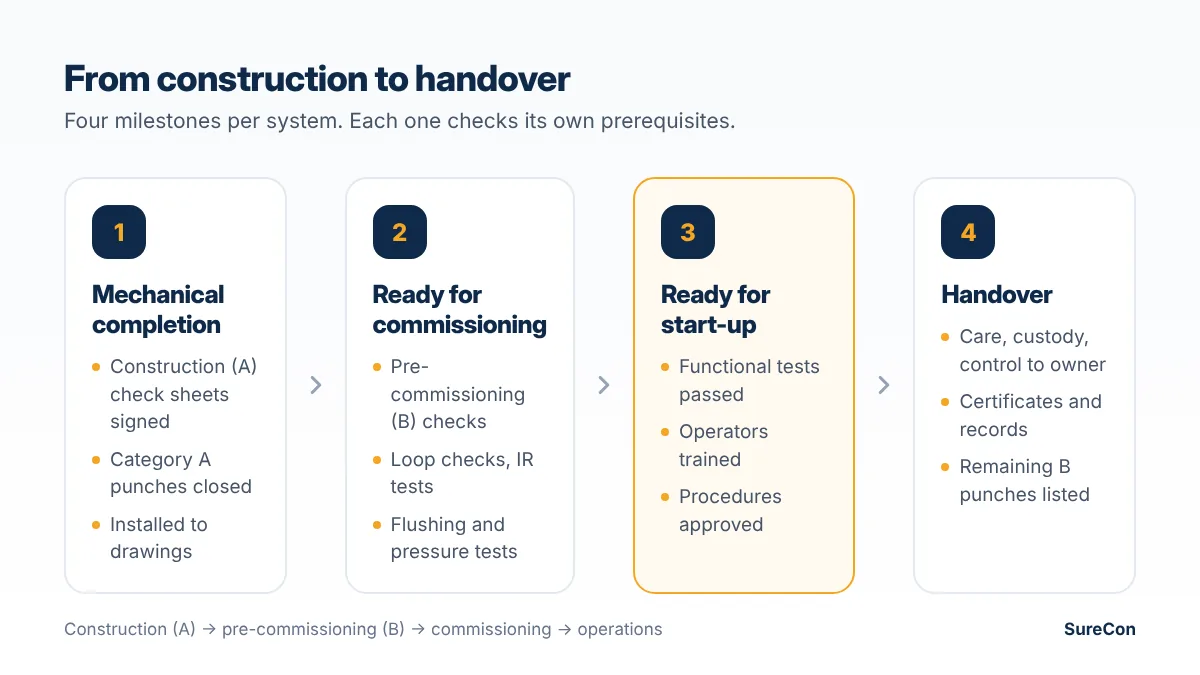
- Check sheets (also called ITRs): the forms that record each check on each tag, in phases. A sheets are construction checks, B sheets pre-commissioning, C sheets commissioning.
- Punch items: defects or unfinished work found along the way, each with a category saying how urgent it is.
- Certificates: milestones such as mechanical completion, ready for commissioning and handover, each signed when its prerequisites are met.
- The turnover dossier: all the records for a system, handed to the owner with the system itself.
Who does completions?
Usually a small completions team, led by a completions manager, runs the system and the registers. But the records are created by everyone: contractors sign construction check sheets, inspectors verify them and raise punches, commissioning engineers carry out tests, and the client witnesses hold points and accepts the handover. The completions team's job is to make that easy and to make gaps visible.
When does it start?
Too many projects start completions when construction is nearly finished. By then, half the evidence is lost. The best projects set up systems, tags and check sheets before the first piece of equipment is installed, so each check is recorded on the day the work is done.
What you get from doing it well
- Commissioning starts on time, because systems are really ready.
- Fewer surprises at start-up, because checks weren't skipped.
- Shorter handover, because the dossier builds itself as you go.
- Fewer disputes, because every punch and every signature is recorded.
- A safer plant, because nothing is energised or pressurised before it's been checked.
Next in the academy
The next lesson explains how a completions management system works: how tags, check sheets, punches and certificates connect, and why that connection is what saves the time.