
Completions
Mechanical completion to handover: a plain-English guide
MC, RFC, RFSU, handover. What each milestone means, what has to be true before you sign it, and how to stop the last 10 % taking 50 % of the time.
· 6 min read

Every project team knows the feeling. Construction is “95 % done”, yet handover keeps slipping. The work isn't the problem. The proof is: hundreds of check sheets, punch items, test records and certificates that need to come together for every system.
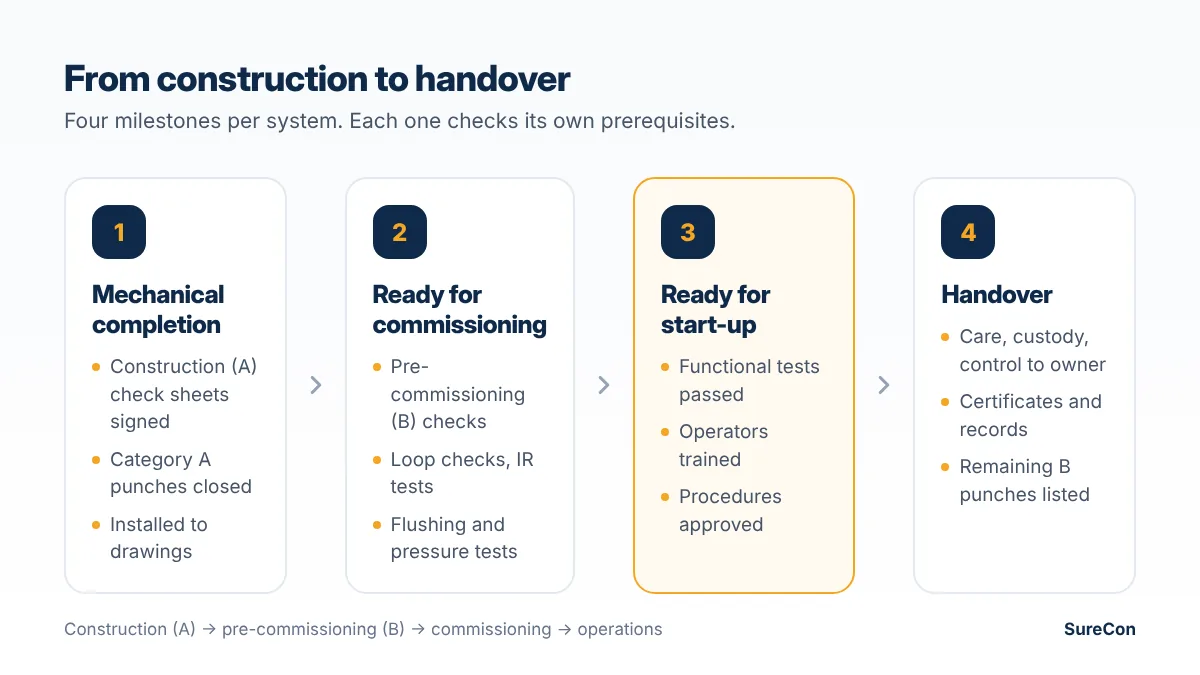
Completions is the discipline of making that proof flow. Here is how the milestones fit together.
1. Mechanical completion (MC)
A system is mechanically complete when it's installed per the drawings and specifications, and the construction check sheets (the “A” sheets) for every tag in it are signed. Category A punch items, the ones that stop the next step, must be closed. Category B items can carry forward.
2. Ready for commissioning (RFC)
Pre-commissioning checks (the “B” sheets) prove the system can be safely energised or pressurised: loop checks, insulation resistance, flushing, pressure tests. When they're done, commissioning can take over.
3. Ready for start-up (RFSU)
Commissioning has run the system with its real process or a safe substitute. Operators are trained, procedures are approved, and safety systems are proven. The plant is ready to start.
4. Handover
Care, custody and control pass to the owner, along with the complete record: certificates, test results, vendor documents and the remaining punch list.
Why the last 10 % drags
- Check sheets live in different folders, so nobody knows what's missing for a system.
- Punch lists are spreadsheets emailed around, always out of date.
- Certificates are assembled by hand the night before a milestone.
- Nobody can see progress by system, only by discipline or area.
How SureCon helps
In SureCon every tag belongs to a subsystem, every check sheet belongs to a tag, and every certificate checks its own prerequisites. The overview shows each system's stage at a glance, and a certificate can only be signed when what it depends on is genuinely done. The binder builds itself as you work.